
Hub Protocol
Hub Protocol is the local protocol DotCraft clients use to discover and manage workspace AppServers, intended for Desktop, CLI, editor extensions, and other local clients. TypeScript and .NET applications use the DotCraft SDK Hub API instead — it already implements discovery, binary policy, structured errors, and AppServer bootstrap. Use this raw HTTP/SSE contract for a custom transport, an unsupported language, or protocol debugging.
Hub only coordinates local runtimes: it manages workspace AppServers through an HTTP JSON API and broadcasts lifecycle events over Server-Sent Events. It is not a session proxy and exposes no AppServer JSON-RPC methods. After appservers/ensure returns an endpoint, clients connect directly to the AppServer WebSocket, and session traffic uses AppServer Protocol. Clients that connect to a remote AppServer, or manage the AppServer process themselves, do not need Hub.
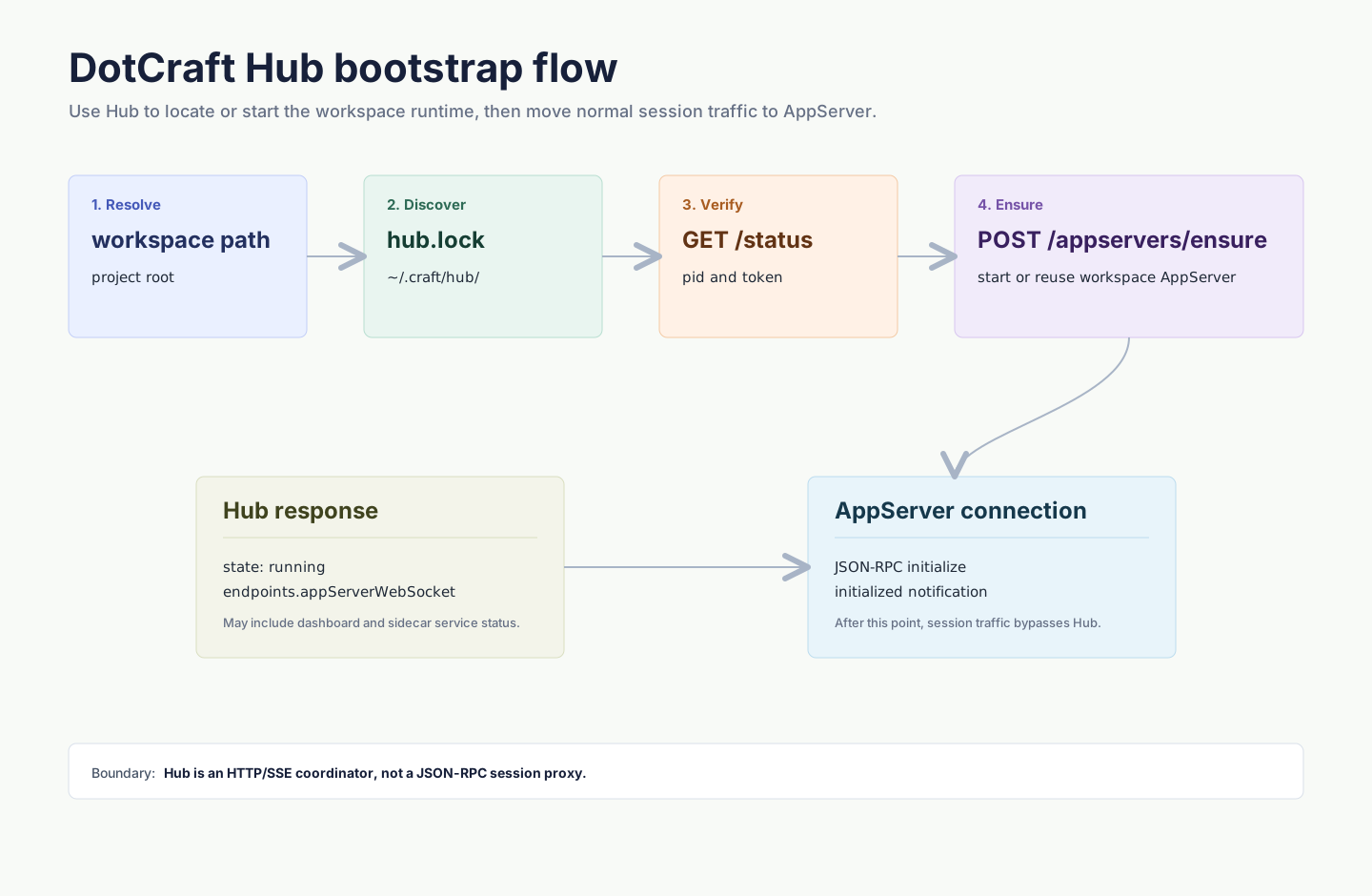
Protocol
Hub Local API uses HTTP JSON over loopback. All JSON fields use camelCase.
| Capability | Description |
|---|---|
| Discovery | Read ~/.craft/hub/hub.lock |
| API transport | HTTP JSON |
| Event transport | Server-Sent Events (GET /v1/events) |
| Address | Loopback by default |
| Auth | Protected endpoints use Authorization: Bearer <token> |
| Status check | GET /v1/status is public |
Typical hub.lock content:
{
  "pid": 12345,
  "apiBaseUrl": "http://127.0.0.1:49231",
  "token": "local-random-token",
  "startedAt": "2026-04-30T06:30:00Z",
  "version": "0.1.0",
  "binaryPath": "/path/to/dotcraft"
}
After reading the lock file, verify each of these:
- The recorded
pidstill points to a live process. GET {apiBaseUrl}/v1/statussucceeds.- The returned
apiBaseUrl, version, capabilities, and optionalbinaryPathmatch what the client expects.
When any check fails, discard that lock file, start dotcraft hub, and run discovery again.
Authentication
Every management endpoint except GET /v1/status requires a bearer token:
Authorization: Bearer <token-from-hub-lock>Unauthorized response:
{
  "error": {
    "code": "unauthorized",
    "message": "Missing or invalid Hub token.",
    "details": null
  }
}
Hub is a same-OS-user local coordinator, not a cross-user security boundary. Do not expose the Hub API on a non-loopback network.
API overview
| Endpoint | Auth | Description |
|---|---|---|
GET /v1/status | no | Return Hub metadata and capabilities. |
POST /v1/shutdown | yes | Stop Hub and trigger managed AppServer cleanup. |
POST /v1/appservers/ensure | yes | Ensure a workspace AppServer is available, starting it if needed. |
GET /v1/appservers | yes | List live and known workspace AppServers. |
GET /v1/appservers/by-workspace?path=... | yes | Inspect one workspace without starting a process. |
POST /v1/appservers/stop | yes | Stop one Hub-managed workspace AppServer. |
POST /v1/appservers/restart | yes | Restart a workspace AppServer. |
POST /v1/services/ensure | yes | Start or reuse a registered product-owned local service. |
GET /v1/services/by-id?id=... | yes | Inspect one registered local service without starting it. |
POST /v1/services/stop | yes | Stop one Hub-managed local service. |
POST /v1/services/restart | yes | Replace one registered local service process. |
GET /v1/events | yes | Subscribe to Hub lifecycle events. |
POST /v1/notifications/request | yes | Request a local notification for Desktop or tray UI. |
GET /v1/status
Example response:
{
  "hubVersion": "0.1.0",
  "pid": 12345,
  "startedAt": "2026-04-30T06:30:00Z",
  "statePath": "/Users/me/.craft/hub",
  "apiBaseUrl": "http://127.0.0.1:49231",
  "binaryPath": "/path/to/dotcraft",
  "capabilities": {
    "appServerManagement": true,
    "managedServiceManagement": true,
    "portManagement": true,
    "events": true,
    "notifications": true,
    "tray": false
  }
}
tray: false means Hub is headless. Desktop owns tray and notification UI.
POST /v1/appservers/ensure
Example request:
{
  "workspacePath": "/Users/me/project",
  "client": {
    "name": "my-client",
    "version": "0.1.0"
  },
  "startIfMissing": true,
  "runtimeTools": {
    "ripgrepPath": "/absolute/path/to/rg"
  }
}
Example response:
{
  "workspacePath": "/Users/me/project",
  "canonicalWorkspacePath": "/Users/me/project",
  "state": "running",
  "pid": 23456,
  "endpoints": {
    "appServerWebSocket": "ws://127.0.0.1:49300/ws?token=..."
  },
  "serviceStatus": {
    "appServerWebSocket": {
      "state": "allocated",
      "url": "ws://127.0.0.1:49300/ws?token=...",
      "reason": null
    },
    "dashboard": {
      "state": "disabled",
      "url": null,
      "reason": "Dashboard or tracing is disabled."
    }
  },
  "serverVersion": "0.1.0",
  "startedByHub": true,
  "exitCode": null,
  "lastError": null,
  "recentStderr": null
}
Important fields:
state: one ofstopped,starting,running,unhealthy,stopping,exited.endpoints.appServerWebSocket: the URL your client should use for AppServer Protocol.serviceStatus: optional service state fordashboardand runtime helpers.startedByHub: whether the current process is managed by this Hub.
If startIfMissing is false, clients can inspect state without creating a new process.
runtimeTools contains optional local runtime hints. Desktop uses it to pass its bundled rg executable, TypeScript module runtime, and built-in plugin roots to AppServer. Hub only forwards these values as environment variables such as DOTCRAFT_RG_PATH, DOTCRAFT_MODULES_DIR, and DOTCRAFT_BUILTIN_PLUGIN_ROOTS; it does not echo them in status responses.
If Hub finds a stale workspace appserver.lock, it removes the stale lock and continues. If the lock points to a live AppServer whose appServerWebSocket endpoint accepts an initialize handshake, Hub may return that endpoint with startedByHub: false and serviceStatus entries marked external. If the live lock cannot be safely reused, Hub returns workspaceLocked.
Stop and restart
Stop request:
{
  "workspacePath": "/Users/me/project"
}
Restart uses the same body and may also include runtimeTools.
Product-owned local services
Managed local services are a closed DotCraft product facility. Plugin and Marketplace manifests cannot register processes through this API. The current build registers oratorio as a user-level service.
Ensure request:
{
  "serviceId": "oratorio",
  "startIfMissing": true,
  "executable": "/absolute/path/to/oratorio"
}
The host resolves executable. Clients cannot supply arguments, environment variables, a state directory, or a health path. Concurrent ensure calls reuse the same healthy process.
{
  "serviceId": "oratorio",
  "state": "running",
  "pid": 24567,
  "endpoint": "http://127.0.0.1:49310",
  "accessToken": "ephemeral-service-token",
  "version": "0.5.2",
  "lastError": null,
  "recentStderr": null
}
Treat endpoint and accessToken as host-only credentials. Do not pass them to a renderer, log them, or persist them. Service state is in-memory for the Hub lifetime. Hub stops owned processes during shutdown but does not automatically restart a failed service.
Use { "serviceId": "oratorio" } for stop. Restart also requires the resolved executable.
Notifications
Notification request:
{
  "workspacePath": "/Users/me/project",
  "kind": "turn.completed",
  "title": "Task completed",
  "body": "The agent finished the requested change.",
  "severity": "success",
  "source": "appserver",
  "threadId": "thread_abc",
  "actionUrl": "dotcraft://workspace/open?path=/Users/me/project&threadId=thread_abc",
  "openDesktopOnClick": true
}
Response:
{
  "accepted": true
}
severity is normalized to info, success, warning, or error.
threadId, actionUrl, and openDesktopOnClick are optional. AppServer turn notifications use dotcraft://workspace/open only for threads that originated in Desktop. Notifications for other origins should set openDesktopOnClick: false so a click does not launch Desktop.
Events
Subscribe with:
GET /v1/events
Authorization: Bearer <token>
Accept: text/event-stream
Hub sends standard SSE records:
event: appserver.running
data: {"kind":"appserver.running","at":"2026-04-30T06:31:00Z","workspacePath":"/Users/me/project","data":{"pid":23456,"endpoints":{"appServerWebSocket":"ws://127.0.0.1:49300/ws?token=..."}}}
Known event kinds include:
| Event | Description |
|---|---|
hub.started | Hub has started. |
hub.stopping | Hub is stopping. |
port.allocated | Hub allocated a local port for a service. |
appserver.starting | A workspace AppServer is starting. |
appserver.running | A workspace AppServer is ready. |
appserver.exited | A workspace AppServer exited. |
appserver.unhealthy | A health check failed. |
notification.requested | A local notification is waiting for UI display. |
Event payloads are extensible. Render known fields by kind and ignore unknown ones.
Connect to AppServer
After receiving endpoints.appServerWebSocket, open that WebSocket and initialize AppServer Protocol:
{
  "jsonrpc": "2.0",
  "id": 0,
  "method": "initialize",
  "params": {
    "clientInfo": {
      "name": "my-client",
      "title": "My Client",
      "version": "0.1.0"
    },
    "capabilities": {
      "approvalSupport": true,
      "streamingSupport": true
    }
  }
}
Then send:
{
  "jsonrpc": "2.0",
  "method": "initialized",
  "params": {}
}
See AppServer Protocol for session methods.
Errors
Errors use one shape:
{
  "error": {
    "code": "workspaceLocked",
    "message": "A live process appears to own the workspace AppServer lock.",
    "details": {
      "workspacePath": "/Users/me/project",
      "pid": 23456
    }
  }
}
Common error codes:
| Code | HTTP | Description |
|---|---|---|
unauthorized | 401 | Missing or invalid token. |
workspaceNotFound | 400/404 | Workspace path is missing, does not exist, or is not a DotCraft workspace. |
workspaceLocked | 409 | Another live AppServer owns the workspace lock and could not be safely reused. |
appServerStartFailed | 500 | Managed AppServer failed during startup. |
appServerUnhealthy | 500 | Managed AppServer failed readiness or health checks. |
portUnavailable | 500 | Hub could not allocate a required local port. |
invalidNotification | 400 | Notification request is invalid. |
managedServiceNotRegistered | 404 | The service ID is not registered by this DotCraft build. |
managedServiceExecutableRequired | 400 | Starting or restarting requires a host-resolved executable. |
managedServiceExecutableNotFound | 400 | The resolved executable does not exist. |
managedServiceStartFailed | 503 | The service failed readiness or health checks. |
hubInternalError | 500 | Hub encountered an unexpected internal error. |
Client recommendations
- Use Hub by default for local workspaces, while keeping explicit remote AppServer mode as an advanced path.
- After starting Hub, reread
hub.lockand verify/v1/status; do not assume the process is ready immediately. - Render
appserver.unhealthyandappserver.exitedas actionable UI states, such as "restart workspace runtime." - Do not log Hub tokens or AppServer tokens.
- Keep unknown endpoints, service statuses, and event kinds forward-compatible.
Related docs
- Hub local coordination — the Hub process itself: lifecycle, state directory, and port allocation.
- AppServer mode — the process this API starts and manages.
- SDK quickstart — a ready-made implementation of the discovery and bootstrap flow.